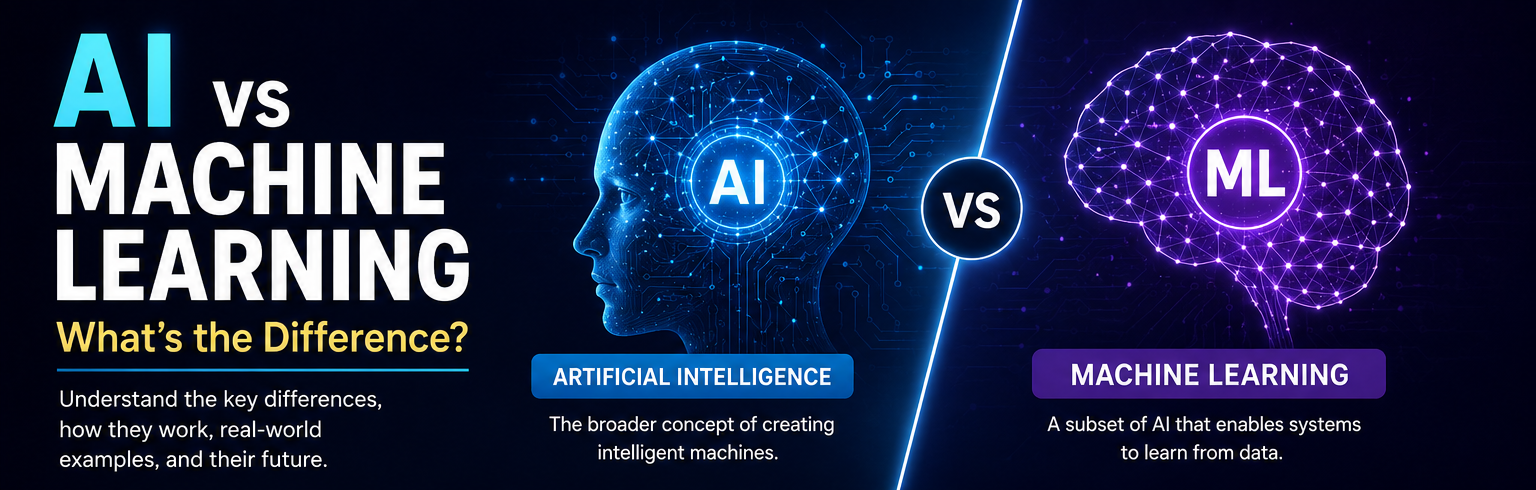
AI vs Machine Learning: What’s the Difference? (2026)
Introduction
Artificial Intelligence (AI) and Machine Learning (ML) are two of the most talked-about technologies in today’s digital world. They are often used interchangeably in news articles, business discussions, and technology blogs. However, while they are closely related, they are not the same.
Artificial Intelligence is the broader concept of creating machines capable of performing tasks that normally require human intelligence. Machine Learning is one of the techniques used to achieve that goal. In simple terms, every Machine Learning system is part of Artificial Intelligence, but not every Artificial Intelligence system uses Machine Learning.
Understanding the difference between AI and ML is important whether you’re a student, business owner, or simply interested in modern technology. This guide explains the relationship between these technologies in simple language, highlights their differences, and explores how they are used in everyday life.
What Is Artificial Intelligence?
Artificial Intelligence is the science of developing computer systems that can perform tasks such as learning, reasoning, planning, recognizing images, understanding language, and solving problems.
AI aims to simulate aspects of human intelligence. Some AI systems use predefined rules, while others learn from data using Machine Learning.
Examples of AI include:
- Voice assistants like Siri and Google Assistant
- AI chatbots
- Self-driving vehicle technology
- Facial recognition systems
- Smart recommendation engines
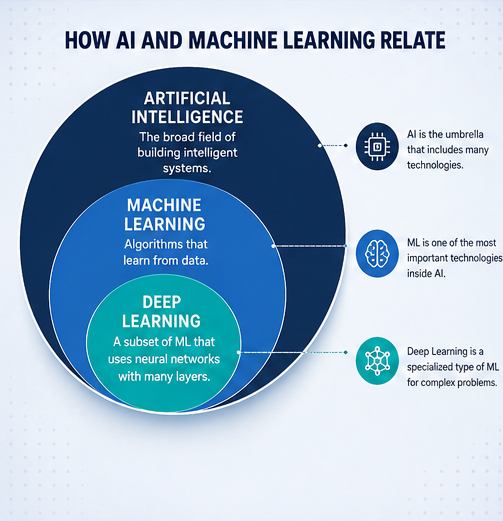
Artificial Intelligence is the umbrella under which several technologies, including Machine Learning, Deep Learning, Natural Language Processing, and Computer Vision, operate.
What Is Machine Learning?
Machine Learning is a subset of Artificial Intelligence that enables computers to learn from data instead of relying only on programmed instructions.
Rather than telling a computer every rule, developers train Machine Learning models using large datasets. The system identifies patterns and improves its predictions over time.
Examples include:
- Email spam filters
- Product recommendations
- Fraud detection
- Medical diagnosis support
- Weather prediction
Machine Learning is one of the most widely used technologies within AI because it allows systems to improve as they process more information.
AI vs Machine Learning: Key Differences
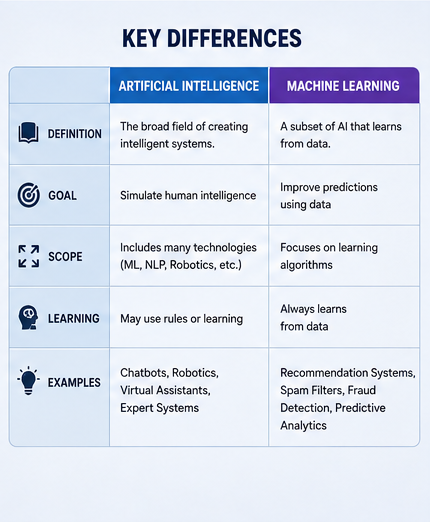
Although AI and ML work together, they have different goals and capabilities.
| Feature | Artificial Intelligence | Machine Learning |
|---|---|---|
| Definition | Broad field of creating intelligent systems | A subset of AI that learns from data |
| Goal | Simulate human intelligence | Improve predictions using data |
| Scope | Includes many technologies | Focuses on learning algorithms |
| Learning | May use rules or learning | Always learns from data |
| Examples | Chatbots, robotics, virtual assistants | Recommendation systems, spam filters, fraud detection |
A simple way to remember the relationship is:
Artificial Intelligence is the complete field. Machine Learning is one important branch within it.
How AI and Machine Learning Work Together
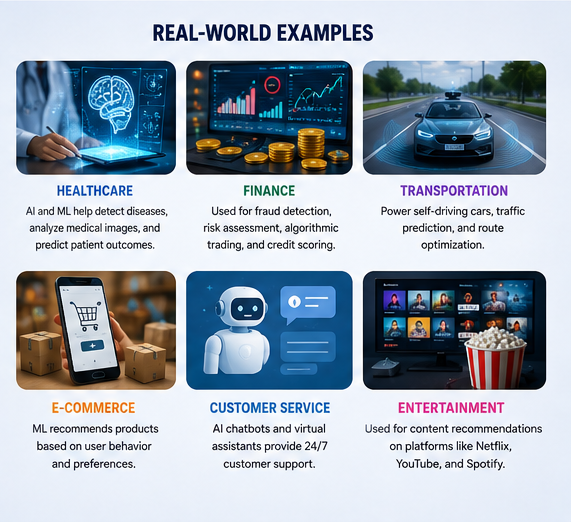
Many modern AI applications rely on Machine Learning to make intelligent decisions.
For example:
Virtual Assistants
Voice assistants use Artificial Intelligence to understand requests, while Machine Learning improves speech recognition over time.
Streaming Platforms
Recommendation systems on streaming services use Machine Learning to analyze viewing habits. Artificial Intelligence then uses those predictions to personalize recommendations.
Healthcare
Doctors use AI-powered software that includes Machine Learning models trained to detect diseases from medical images.
This combination makes AI systems smarter and more accurate.
Real-World Examples
Artificial Intelligence Examples
- Smart assistants
- Autonomous robots
- AI customer support
- Language translation
- Image recognition
Machine Learning Examples
- Netflix recommendations
- Bank fraud detection
- Spam email filtering
- Sales forecasting
- Predictive maintenance
Notice that many Machine Learning applications are part of larger AI systems.
Advantages of Artificial Intelligence
Artificial Intelligence provides several benefits:
- Automates repetitive work
- Supports faster decision-making
- Improves customer service
- Increases productivity
- Reduces operational costs
- Enables innovation across industries
Advantages of Machine Learning
Machine Learning offers additional strengths:
- Learns from new data
- Detects hidden patterns
- Improves prediction accuracy
- Handles large datasets efficiently
- Powers personalized experiences
Common Misconceptions
“AI and Machine Learning are identical.”
False.
Machine Learning is only one branch of Artificial Intelligence.
“Every AI system learns automatically.”
Not always.
Some AI systems rely on predefined rules rather than learning from data.
“Machine Learning can replace all human decisions.”
No.
Machine Learning assists humans by providing predictions and recommendations, but human judgment remains essential in many situations.
Which Technology Has the Bigger Future?
Artificial Intelligence and Machine Learning are expected to grow together.
AI will continue expanding into healthcare, education, transportation, finance, manufacturing, cybersecurity, and scientific research.
Machine Learning will remain one of the primary technologies driving AI because modern intelligent systems depend heavily on learning from data.
As computing power increases and better datasets become available, both fields are expected to become even more important.
Frequently Asked Questions
Is Machine Learning part of Artificial Intelligence?
Yes. Machine Learning is one of the most important branches of Artificial Intelligence.
Can Artificial Intelligence exist without Machine Learning?
Yes. Some AI systems use predefined rules instead of learning algorithms.
Which should I learn first?
Beginners should understand the fundamentals of Artificial Intelligence before studying Machine Learning in greater depth.
Is Deep Learning the same as Machine Learning?
No. Deep Learning is a specialized branch of Machine Learning that uses artificial neural networks to solve complex problems.
Conclusion
Artificial Intelligence and Machine Learning are closely connected but serve different purposes. Artificial Intelligence focuses on creating systems that can perform intelligent tasks, while Machine Learning gives those systems the ability to improve through experience and data.
Understanding the distinction between these technologies helps individuals make better decisions, whether they are learning new skills, running a business, or following the latest developments in technology.
As AI continues transforming industries around the world, knowing how Machine Learning fits into the bigger picture provides a strong foundation for understanding the future of innovation.
