What Is Machine Learning? A Complete Beginner’s Guide (2026)
Introduction
Machine Learning (ML) is one of the most exciting fields in modern technology. It powers the recommendations you see on Netflix, helps banks detect fraudulent transactions, enables voice assistants to understand your commands, and even assists doctors in diagnosing diseases.
Although Machine Learning sounds complicated, the idea behind it is surprisingly simple. Instead of telling a computer exactly what to do through detailed instructions, developers give it data so it can learn patterns and make predictions on its own.
Machine Learning is a branch of Artificial Intelligence (AI), and together they are changing how businesses, governments, and individuals solve problems. As AI continues to grow, understanding Machine Learning has become valuable not only for technology professionals but also for students, business owners, and anyone interested in the future of innovation.
In this beginner-friendly guide, you’ll learn what Machine Learning is, how it works, the different types of Machine Learning, real-world examples, its benefits, challenges, and how it differs from Artificial Intelligence.
What Is Machine Learning?
Machine Learning is a branch of Artificial Intelligence that enables computers to learn from data without being explicitly programmed for every possible situation.
Traditional software follows fixed instructions written by developers. Machine Learning systems, on the other hand, analyze data, recognize patterns, and improve their predictions over time.
For example, instead of programming every rule needed to identify spam emails, a Machine Learning model is trained using thousands or even millions of examples of both spam and legitimate emails. As it processes more data, it becomes increasingly accurate at recognizing unwanted messages.
This ability to learn from experience is what makes Machine Learning so powerful.
How Does Machine Learning Work?
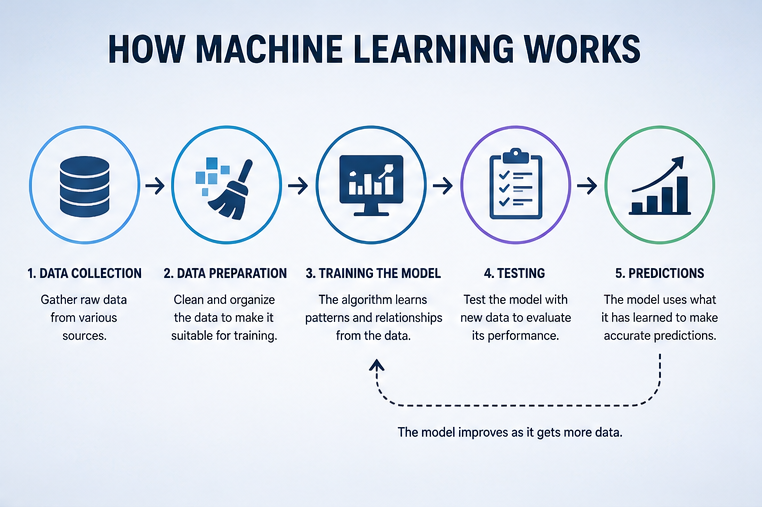
Machine Learning follows a structured process that allows computers to improve their performance through data analysis.
1. Data Collection
Everything begins with data. This can include text, images, videos, customer purchases, weather information, financial records, or medical reports.
The more relevant and accurate the data, the better the model can learn.
2. Data Preparation
Before training begins, the data is cleaned and organized. Duplicate entries, missing values, and errors are removed to improve the quality of the learning process.
3. Training the Model
The prepared data is used to train a Machine Learning algorithm. During training, the algorithm identifies patterns and relationships within the data.
4. Testing
After training, the model is tested using new data it has never seen before. This measures how well it performs in real-world situations.
5. Predictions
Once trained, the model can make predictions or decisions based on new information.
As more data becomes available, many Machine Learning systems continue improving their accuracy.
Types of Machine Learning
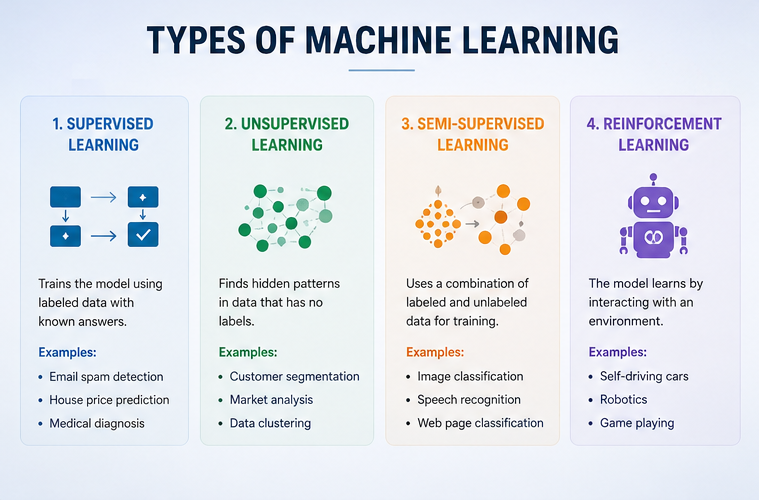
Machine Learning can be divided into four main categories.
1. Supervised Learning
Supervised Learning uses labeled data, meaning the correct answers are already known during training.
Examples include:
- Email spam detection
- House price prediction
- Medical diagnosis
- Credit risk assessment
2. Unsupervised Learning
Unsupervised Learning works with data that has no labels. The algorithm identifies hidden patterns and groups similar information together.
Examples include:
- Customer segmentation
- Product recommendations
- Market analysis
- Data clustering
3. Semi-Supervised Learning
This approach combines a small amount of labeled data with a much larger amount of unlabeled data. It is commonly used when labeling large datasets is expensive or time-consuming.
4. Reinforcement Learning
In Reinforcement Learning, an AI system learns through trial and error by receiving rewards for good decisions and penalties for poor ones.
Examples include:
- Self-driving vehicles
- Robotics
- Video game AI
- Industrial automation
Real-World Applications of Machine Learning
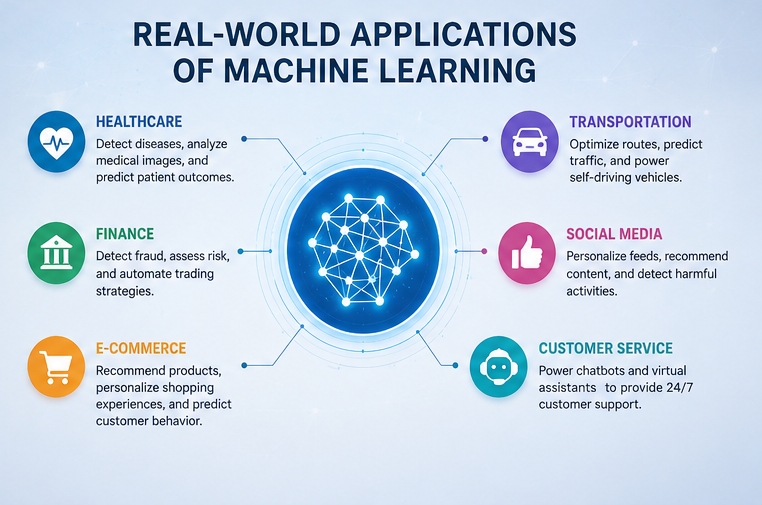
Machine Learning is already part of everyday life, even if many people don’t realize it.
Healthcare
Doctors use Machine Learning to detect diseases earlier, analyze medical scans, and predict patient outcomes.
Banking and Finance
Banks use Machine Learning to detect fraud, evaluate loan applications, and identify suspicious transactions in real time.
E-commerce
Online stores recommend products based on browsing history, purchases, and customer preferences.
Social Media
Platforms like Instagram, Facebook, and TikTok use Machine Learning to personalize content feeds and recommend videos.
Transportation
Navigation apps calculate the fastest routes using traffic patterns, while autonomous vehicle technology relies heavily on Machine Learning.
Customer Service
Businesses use Machine Learning to power chatbots and virtual assistants that answer customer questions around the clock.
Advantages of Machine Learning
Machine Learning offers numerous benefits across industries.
Some of the most significant advantages include:
- Automates repetitive tasks
- Improves decision-making
- Detects patterns humans may overlook
- Processes massive amounts of data quickly
- Reduces operational costs
- Enhances customer experiences
- Increases productivity
- Supports scientific research
- Improves fraud detection
- Enables personalized recommendations
Challenges and Limitations
Despite its advantages, Machine Learning also presents several challenges.
Data Quality
Poor-quality data leads to poor predictions.
Privacy
Many Machine Learning systems rely on large amounts of personal data, raising privacy concerns.
Bias
If training data contains bias, the model may produce unfair results.
Cost
Developing advanced Machine Learning systems requires skilled professionals and significant computing resources.
Explainability
Some complex Machine Learning models make decisions that are difficult for humans to understand, making transparency an important issue.
Machine Learning vs Artificial Intelligence
Although the terms are often used interchangeably, they are not the same.
| Artificial Intelligence | Machine Learning |
|---|---|
| Broader field of creating intelligent systems | A branch of AI |
| Includes reasoning, planning, robotics, and more | Focuses on learning from data |
| May use rules or learning algorithms | Always relies on learning from data |
| Larger concept | Smaller subset of AI |
In simple terms, Machine Learning is one of the technologies that makes Artificial Intelligence possible.
Popular Machine Learning Tools
Some widely used Machine Learning frameworks include:
- TensorFlow
- PyTorch
- Scikit-learn
- XGBoost
- Keras
- LightGBM
- CatBoost
These tools help developers build predictive models for everything from image recognition to financial forecasting.
The Future of Machine Learning
Machine Learning continues to evolve rapidly. Future developments are expected to improve healthcare, education, transportation, agriculture, cybersecurity, manufacturing, and scientific research.
As computing power increases and more data becomes available, Machine Learning models are likely to become faster, more accurate, and more accessible to businesses of all sizes.
Understanding Machine Learning today can help individuals prepare for a future where intelligent systems play an even greater role in daily life.
Frequently Asked Questions (FAQ)
Is Machine Learning part of Artificial Intelligence?
Yes. Machine Learning is a subset of Artificial Intelligence.
Does Machine Learning require programming?
Basic knowledge of programming is helpful for building Machine Learning models, but many no-code tools now make it easier for beginners to explore ML.
Can Machine Learning make mistakes?
Yes. Machine Learning models are only as good as the data they are trained on. Poor-quality or biased data can lead to incorrect predictions.
Is Machine Learning used only by technology companies?
No. Industries such as healthcare, banking, retail, manufacturing, agriculture, education, and transportation all use Machine Learning.
Conclusion
Machine Learning has become one of the most influential technologies of the modern era. By enabling computers to learn from data and improve over time, it powers countless applications that people use every day.
From personalized shopping recommendations to disease detection and fraud prevention, Machine Learning is already making businesses smarter and improving everyday experiences.
As Artificial Intelligence continues to evolve, understanding Machine Learning will become increasingly valuable for students, professionals, entrepreneurs, and anyone interested in technology. Learning the fundamentals today is a great first step toward understanding the innovations shaping tomorrow.
