What Are Neural Networks? How They Power Modern AI (2026)
What Are Neural Networks? How They Power Modern AI (2026)
Introduction
Neural networks are one of the most important technologies behind modern Artificial Intelligence (AI). They enable computers to recognize images, understand speech, translate languages, recommend products, detect fraud, and even generate realistic text and artwork. From voice assistants and self-driving cars to medical diagnosis and financial forecasting, neural networks power many of the intelligent systems people use every day.
Although the concept may seem complicated, neural networks are designed to imitate the way the human brain processes information. Instead of following a fixed set of instructions, they learn patterns from large amounts of data and improve their performance over time.
In this guide, you’ll learn what neural networks are, how they work, the different types of neural networks, their real-world applications, advantages, challenges, and why they have become the foundation of today’s AI revolution.
What Are Neural Networks?
A neural network is a computer model inspired by the structure and function of the human brain. It consists of connected processing units called neurons that work together to analyze information, recognize patterns, and make predictions.
Rather than relying on manually written rules, neural networks learn by studying examples. During training, they adjust their internal connections until they become better at solving a particular problem.
For example, a neural network trained with millions of images can learn to recognize cats, dogs, cars, or faces without being explicitly programmed to identify each feature.
Why Are They Called Neural Networks?
The name “neural network” comes from the biological neurons found in the human brain.
Your brain contains billions of neurons that communicate through electrical signals. Similarly, artificial neural networks contain many connected artificial neurons that exchange information mathematically.
Although artificial neural networks are much simpler than the human brain, they are inspired by the same basic concept of learning through interconnected units.
How Do Neural Networks Work?
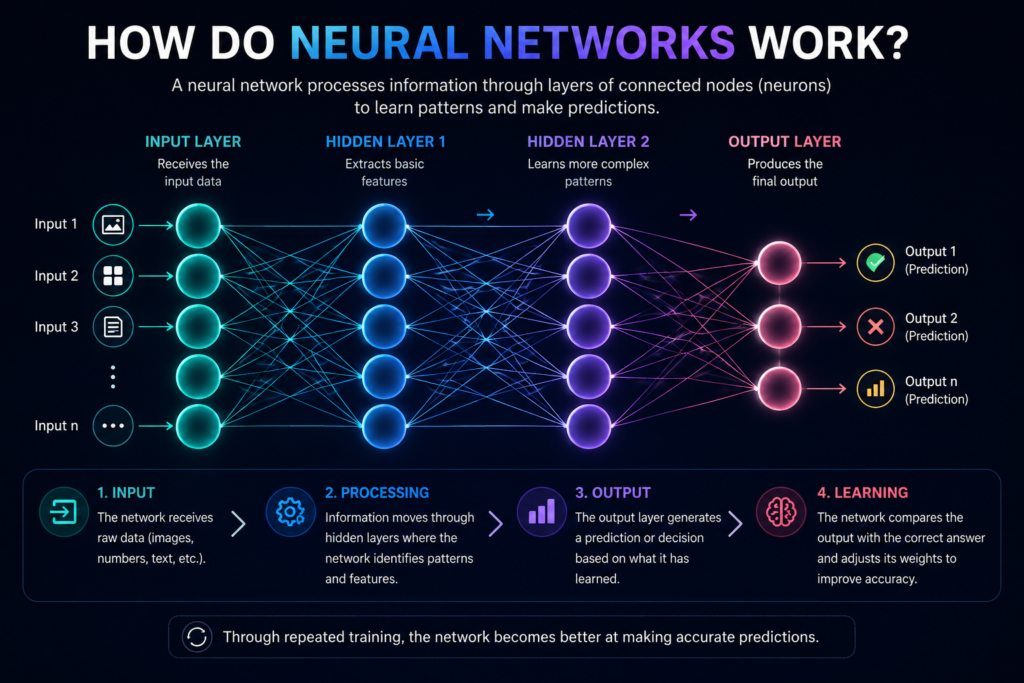
Neural networks process information in several stages.
Step 1: Input Layer
The input layer receives data such as images, numbers, text, or sound.
Step 2: Hidden Layers
The hidden layers process the information by identifying important features and patterns.
Each hidden layer extracts increasingly complex information from the data.
Step 3: Output Layer
The output layer produces the final prediction or decision.
For example:
- Identifying whether an image contains a cat
- Predicting tomorrow’s weather
- Translating a sentence into another language
Step 4: Learning
If the prediction is incorrect, the network adjusts its internal weights using a mathematical process called backpropagation. Repeating this process many times gradually improves accuracy.
Main Components of a Neural Network
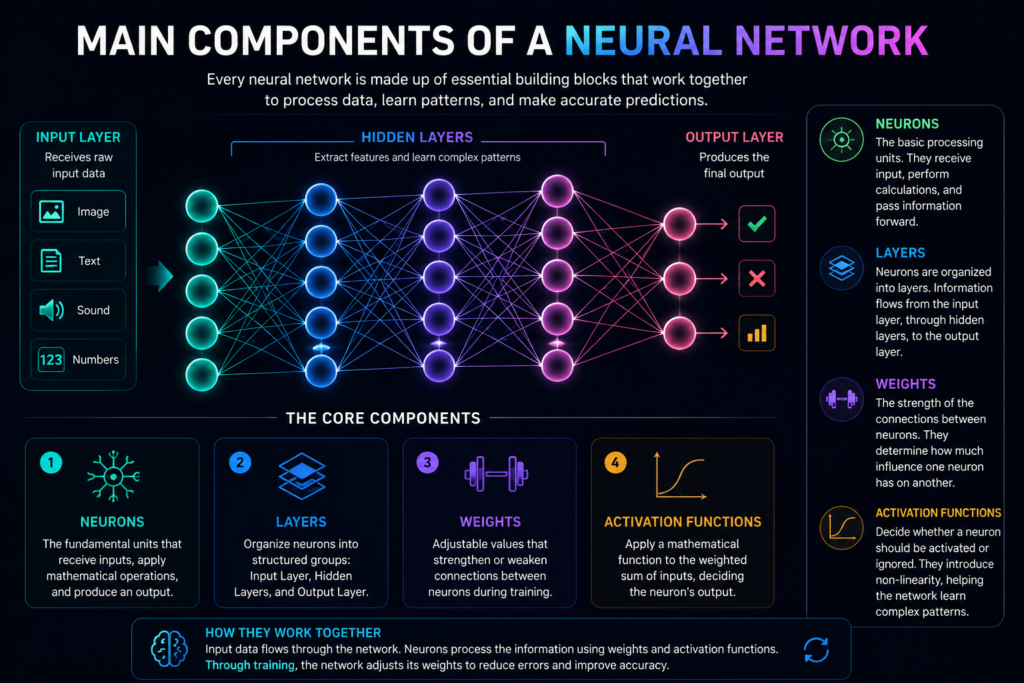
Every neural network contains several important components.
Neurons
Small processing units that receive, analyze, and pass information.
Layers
Neurons are organized into different layers:
- Input layer
- Hidden layers
- Output layer
Weights
Weights determine how strongly one neuron influences another during learning.
Activation Functions
Activation functions decide whether information should move to the next neuron, helping the network solve complex problems.
Types of Neural Networks
Different neural networks are designed for different tasks.
Feedforward Neural Networks
The simplest type of neural network where information moves in one direction from input to output.
Common uses:
- Classification
- Basic predictions
- Pattern recognition
Convolutional Neural Networks (CNNs)
CNNs specialize in image and video recognition.
Applications include:
- Facial recognition
- Medical imaging
- Self-driving cars
- Object detection
Recurrent Neural Networks (RNNs)
RNNs process sequential information, making them useful for language and speech tasks.
Applications include:
- Speech recognition
- Language translation
- Time-series forecasting
Transformer Networks
Transformers have become the leading architecture for modern AI systems.
They power:
- AI chatbots
- Language models
- Text generation
- Code generation
- AI assistants
Neural Networks vs Deep Learning
Many people confuse neural networks with Deep Learning, but they are closely related rather than identical.
| Neural Networks | Deep Learning |
|---|---|
| Basic learning model | Uses multiple neural network layers |
| Can have few hidden layers | Usually has many hidden layers |
| Suitable for smaller problems | Handles highly complex tasks |
| Lower computing requirements | Requires powerful hardware |
| Foundation of AI systems | Advanced branch of Machine Learning |
Deep Learning is essentially an advanced form of neural networks with many hidden layers capable of solving highly complex problems.
Real-World Applications
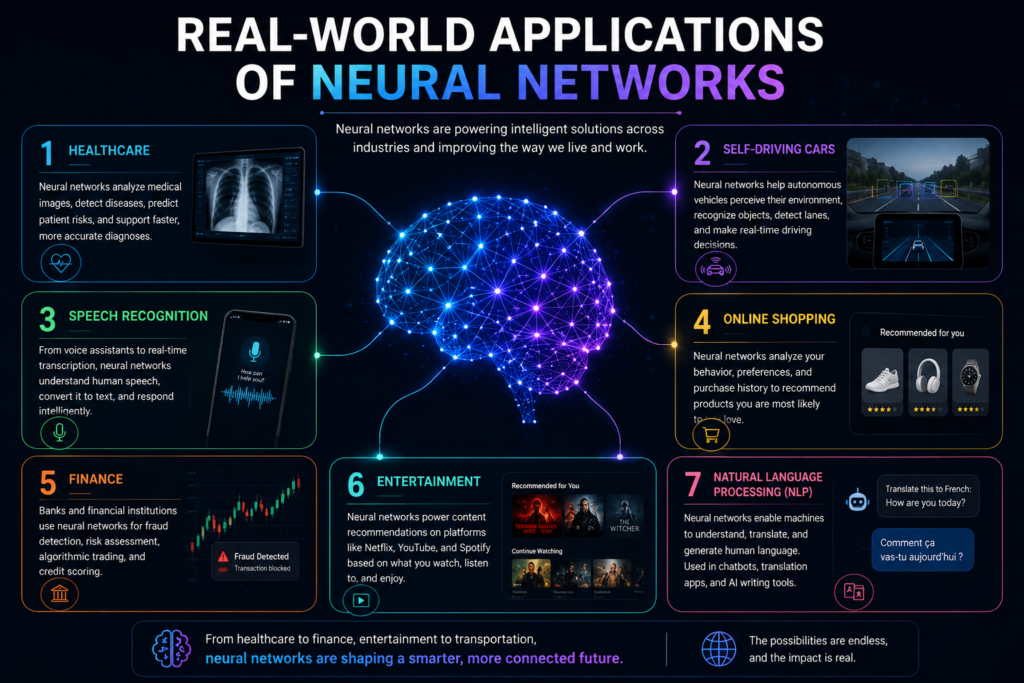
Neural networks are transforming industries around the world.
Healthcare
Doctors use neural networks to detect diseases, analyze medical images, and support faster diagnoses.
Finance
Banks use neural networks to detect fraudulent transactions, assess financial risks, and improve investment strategies.
Self-Driving Cars
Autonomous vehicles rely on neural networks to recognize roads, pedestrians, traffic signs, and nearby vehicles.
Voice Assistants
Virtual assistants such as Siri, Alexa, and Google Assistant use neural networks to understand spoken language and provide accurate responses.
Online Shopping
E-commerce platforms recommend products based on customer behavior and previous purchases.
Entertainment
Streaming services recommend movies, TV shows, and music based on viewing history.
Advantages of Neural Networks
Neural networks offer several important benefits.
- Learn directly from data
- Recognize complex patterns
- Improve accuracy over time
- Handle massive datasets
- Automate repetitive tasks
- Support advanced AI technologies
- Adapt to changing information
Challenges and Limitations
Despite their impressive capabilities, neural networks also have limitations.
Large Data Requirements
Training accurate models often requires massive datasets.
High Computing Costs
Complex neural networks typically require powerful GPUs or specialized hardware.
Long Training Time
Training advanced models may take hours, days, or even weeks.
Limited Explainability
Many neural networks operate as “black boxes,” making it difficult to understand how decisions are made.
Risk of Bias
If training data contains bias, predictions may also become biased.
The Future of Neural Networks
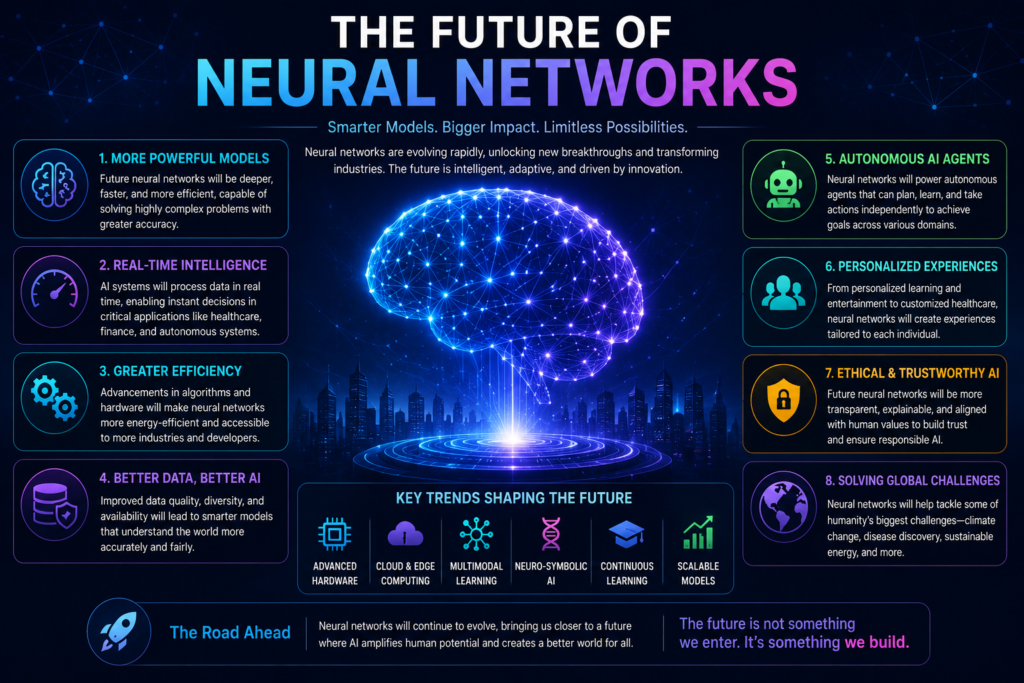
Neural networks continue to evolve rapidly as researchers develop more powerful architectures and training methods.
Future improvements are expected in:
- Healthcare diagnostics
- Robotics
- Autonomous transportation
- Cybersecurity
- Education
- Scientific research
- Space exploration
Generative AI systems that create text, images, videos, music, and computer code also rely heavily on advanced neural network architectures.
Frequently Asked Questions
Are neural networks part of Artificial Intelligence?
Yes. Neural networks are one of the core technologies used in modern Artificial Intelligence systems.
Are neural networks the same as Machine Learning?
No. Neural networks are a type of Machine Learning model used to solve complex problems.
Why are neural networks important?
They allow computers to recognize patterns, make predictions, understand language, analyze images, and continuously improve through learning.
Can neural networks learn by themselves?
They learn from training data provided by developers. Once trained, they can make predictions on new data with high accuracy.
Conclusion
Neural networks have become one of the most powerful technologies in Artificial Intelligence. Inspired by the human brain, they enable computers to recognize patterns, solve complex problems, and improve their performance through experience.
From healthcare and finance to autonomous vehicles and generative AI, neural networks are transforming industries and shaping the future of technology. As AI continues to evolve, understanding neural networks provides valuable insight into how intelligent systems work and why they have become essential to modern innovation.