What Is Deep Learning? A Complete Beginner’s Guide (2026)
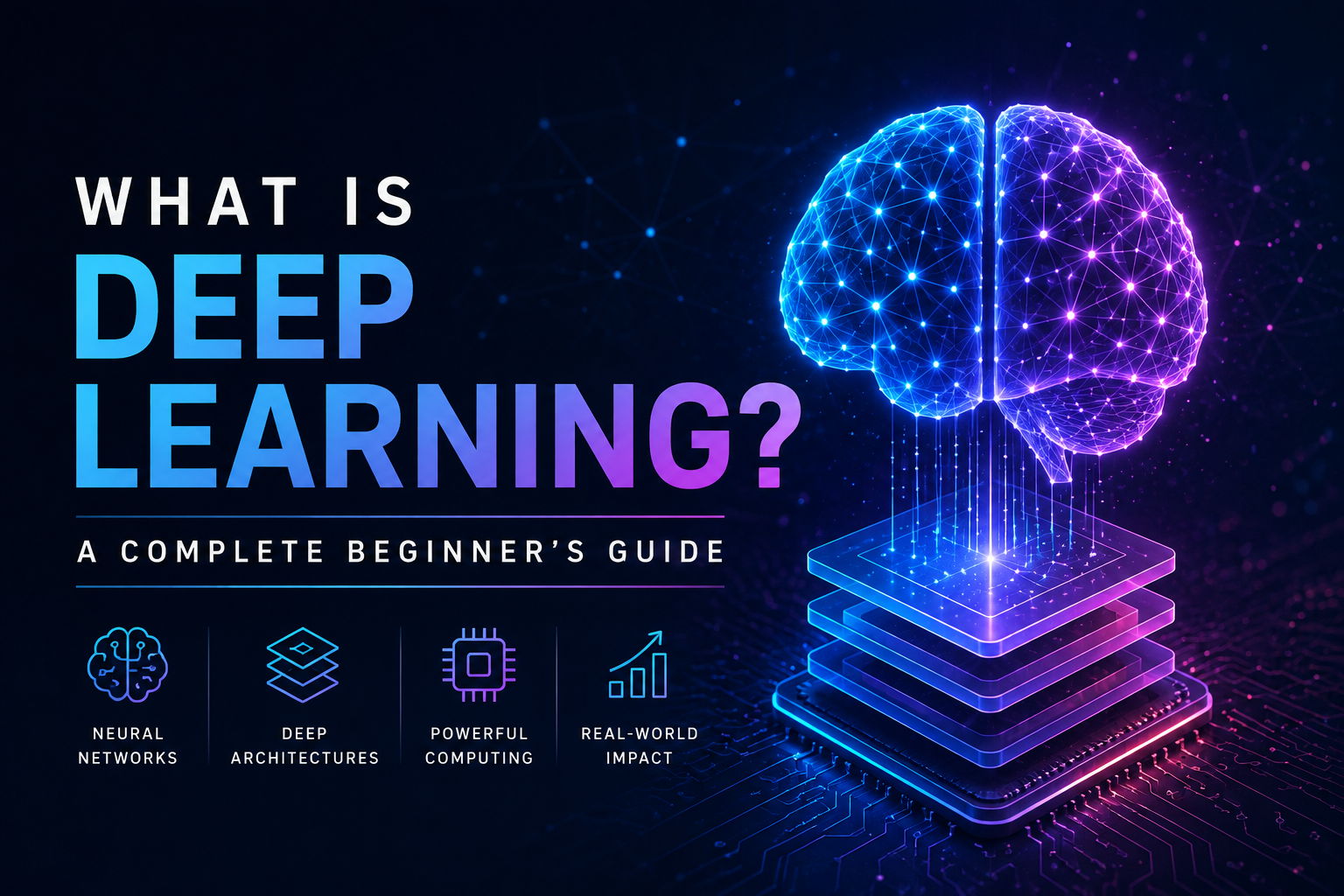
What Is Deep Learning? A Complete Beginner’s Guide (2026)
Introduction
Deep Learning is one of the most powerful technologies behind today’s Artificial Intelligence (AI) revolution. It enables computers to recognize faces, understand speech, translate languages, recommend content, detect diseases, and even generate realistic images and text. Many of the AI tools people use every day rely on Deep Learning to perform tasks that once seemed possible only for humans.
Although the term may sound complex, Deep Learning is simply an advanced form of Machine Learning that allows computers to learn from massive amounts of data using structures inspired by the human brain. Instead of relying on manually programmed rules, Deep Learning systems discover patterns, improve over time, and solve increasingly complex problems.
As industries continue adopting AI, understanding Deep Learning has become valuable for students, professionals, entrepreneurs, and anyone curious about modern technology. In this guide, you’ll learn what Deep Learning is, how it works, how it differs from Machine Learning, where it is used, and why it plays such an important role in the future of Artificial Intelligence.
What Is Deep Learning?
Deep Learning is a branch of Machine Learning that uses artificial neural networks with multiple layers to process information and learn from data. These layered networks allow computers to recognize patterns, make predictions, and solve complex problems with remarkable accuracy.
Traditional computer programs require explicit instructions for every task. Deep Learning systems, however, learn from examples. By analyzing millions of pieces of data, they gradually improve their ability to recognize relationships and make decisions without being programmed for every possible scenario.
For example, instead of manually defining every feature of a cat, a Deep Learning model can study millions of cat images and automatically learn how to recognize one.
How Does Deep Learning Work?
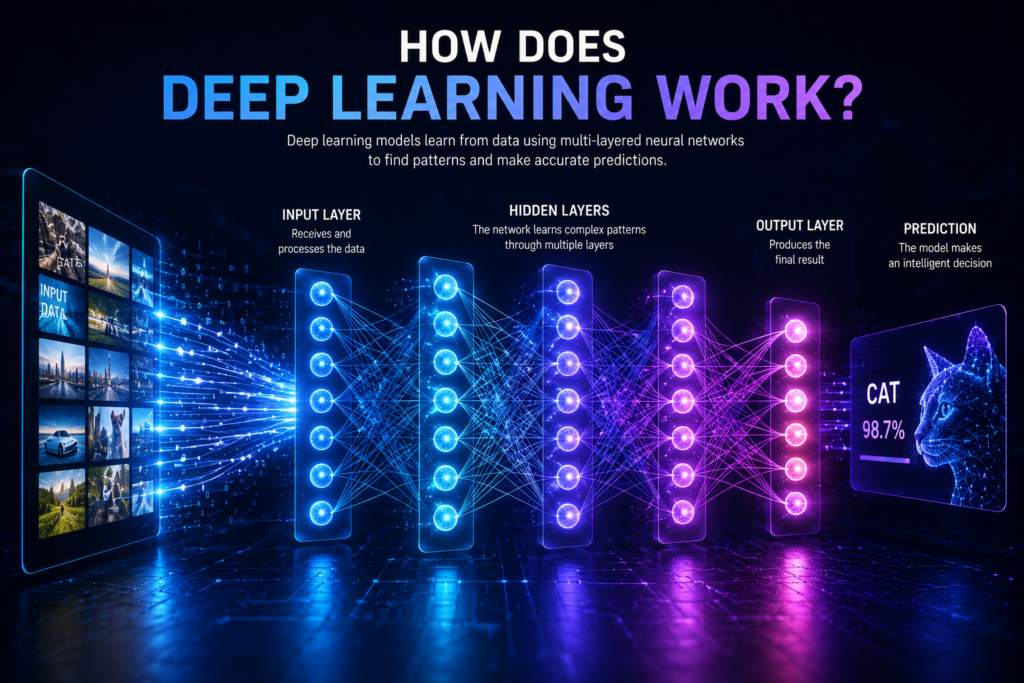
Deep Learning models use artificial neural networks inspired by the way neurons communicate in the human brain.
The process generally follows these steps:
1. Data Collection
The model receives a large dataset containing images, text, audio, video, or other information.
2. Data Processing
The information is converted into numerical values that computers can process efficiently.
3. Neural Network Training
The data passes through multiple hidden layers, where the network gradually learns patterns and relationships.
4. Prediction
After training, the model can analyze new data and make predictions based on what it has learned.
5. Continuous Improvement
With additional training data, many Deep Learning systems continue improving their accuracy over time.
What Are Artificial Neural Networks?
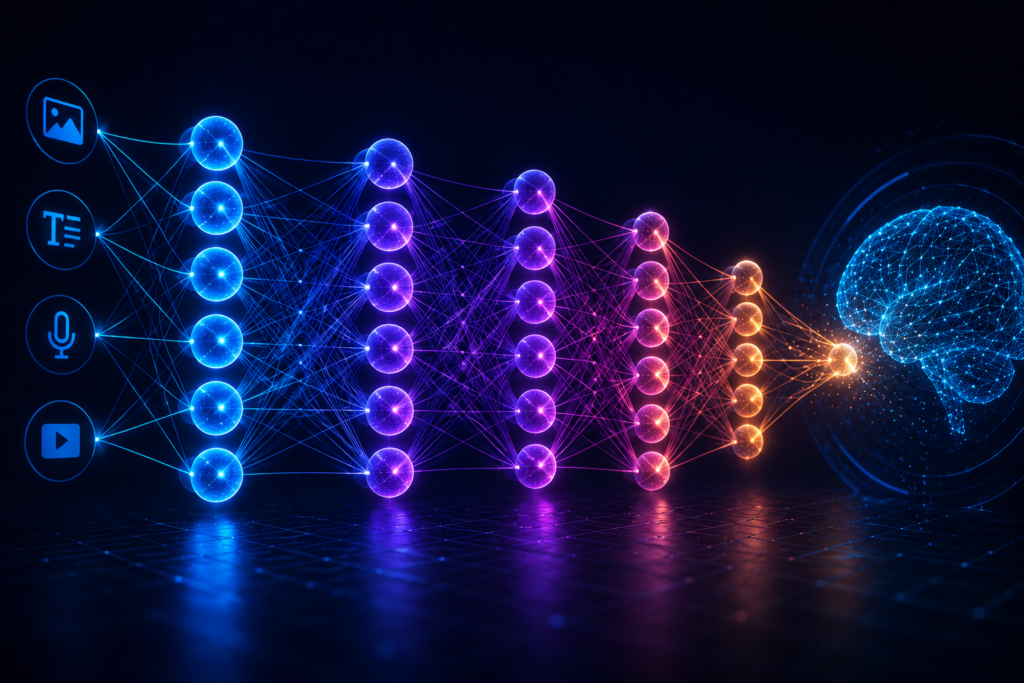
Artificial neural networks are mathematical models designed to imitate the way biological neurons communicate.
A neural network consists of three main parts:
Input Layer
Receives the raw information.
Hidden Layers
Perform calculations and extract meaningful features from the data.
Output Layer
Produces the final prediction or decision.
The greater the number of hidden layers, the “deeper” the network becomes, which is why the technology is called Deep Learning.
Deep Learning vs Machine Learning
Although Deep Learning is part of Machine Learning, there are important differences.
| Feature | Machine Learning | Deep Learning |
|---|---|---|
| Data Requirement | Moderate | Very Large |
| Human Feature Engineering | Usually Required | Mostly Automatic |
| Training Time | Faster | Slower |
| Hardware | Standard CPUs | Often GPUs or TPUs |
| Best For | Structured Data | Images, Audio, Video, Language |
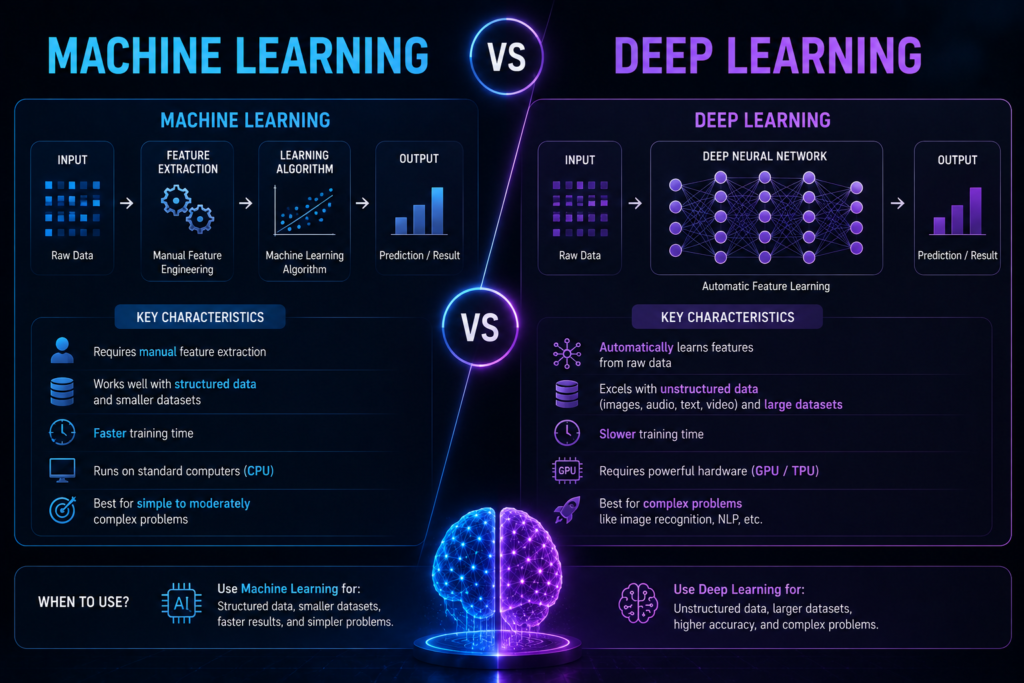
Deep Learning is particularly effective when working with unstructured data, such as photographs, voice recordings, and natural language.
Real-World Applications of Deep Learning
Deep Learning powers many technologies people use every day.
Healthcare
Doctors use Deep Learning to detect diseases from X-rays, MRIs, and CT scans. It also helps researchers discover new medicines and predict patient outcomes.
Self-Driving Cars
Autonomous vehicles rely on Deep Learning to recognize pedestrians, traffic signs, road markings, and other vehicles.
Voice Assistants
Digital assistants like Siri, Alexa, and Google Assistant use Deep Learning to understand spoken language and respond naturally.
Online Shopping
E-commerce platforms recommend products based on browsing history, purchase behavior, and customer preferences.
Cybersecurity
Security systems use Deep Learning to identify suspicious activities and detect cyber threats.
Entertainment
Streaming services recommend movies, TV shows, and music based on viewing and listening habits.
Advantages of Deep Learning
Deep Learning provides several benefits across industries.
- Learns directly from large datasets
- Excellent at image and speech recognition
- High prediction accuracy
- Reduces manual feature engineering
- Continuously improves with more data
- Supports automation of complex tasks
- Powers modern AI innovations
Challenges of Deep Learning
Despite its impressive capabilities, Deep Learning also has limitations.
Requires Large Datasets
Training powerful models often requires millions of data samples.
High Computing Costs
Deep Learning models usually need powerful GPUs or TPUs, making training expensive.
Long Training Times
Large models can take hours, days, or even weeks to train.
Limited Explainability
Some Deep Learning models function as “black boxes,” making it difficult to understand exactly how they reached a particular decision.
Data Bias
If training data contains bias, the model may produce unfair or inaccurate results.
Popular Deep Learning Frameworks
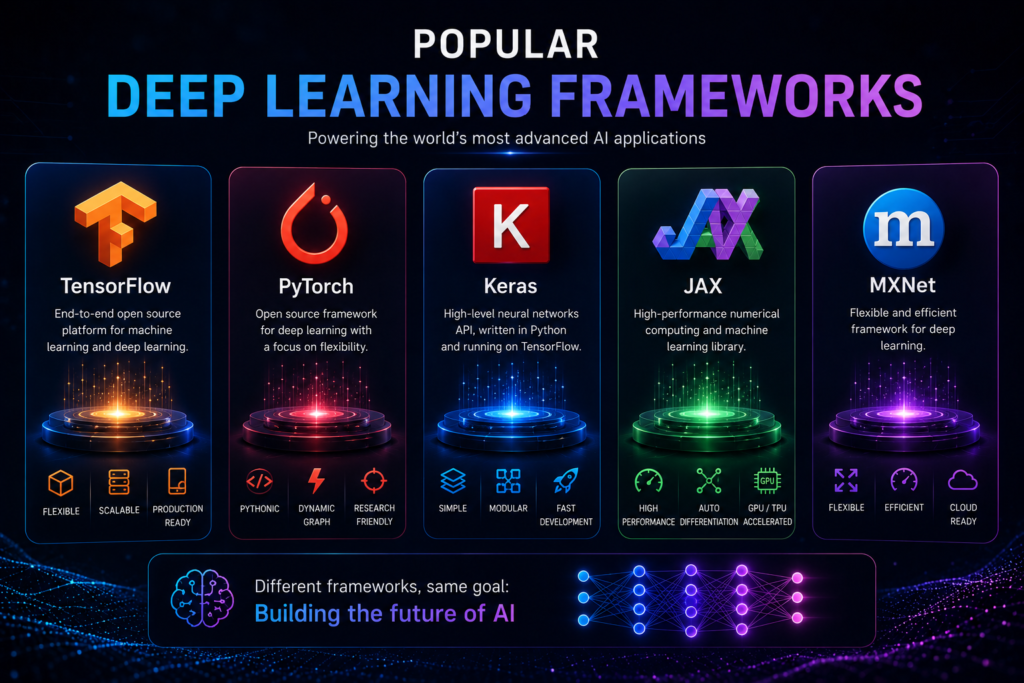
Developers commonly build Deep Learning models using:
- TensorFlow
- PyTorch
- Keras
- JAX
- MXNet
These frameworks simplify building, training, and deploying neural networks.
The Future of Deep Learning
Deep Learning is expected to play an even greater role in future technologies. As computing power increases and more data becomes available, Deep Learning will continue improving areas such as healthcare, robotics, autonomous vehicles, education, finance, manufacturing, and scientific research.
Generative AI systems that create text, images, videos, and music are also powered by advanced Deep Learning techniques, making this field one of the most exciting areas of technological innovation.
Frequently Asked Questions (FAQ)
Is Deep Learning part of Artificial Intelligence?
Yes. Deep Learning is a branch of Machine Learning, which itself is a branch of Artificial Intelligence.
Does Deep Learning require programming?
Most Deep Learning development involves programming languages such as Python and frameworks like TensorFlow or PyTorch.
Why is it called Deep Learning?
The word “deep” refers to the multiple hidden layers inside artificial neural networks.
Is Deep Learning better than Machine Learning?
Not always. Deep Learning performs exceptionally well on complex tasks involving images, audio, and language, while traditional Machine Learning may be more efficient for smaller structured datasets.
Conclusion
Deep Learning has transformed the field of Artificial Intelligence by enabling computers to solve problems that were once considered impossible for machines. From voice assistants and medical diagnosis to self-driving vehicles and generative AI, Deep Learning is shaping the future of technology.
Although it requires significant computing power and large amounts of data, its ability to learn complex patterns has made it one of the most influential technologies of the modern era. Whether you’re a student, entrepreneur, or technology enthusiast, understanding Deep Learning provides valuable insight into how today’s intelligent systems work and where innovation is heading.