How to Sleep Better: 15 Tips for Better Sleep & Health
How to Sleep Better: A Complete Guide to Better Sleep and Healthy Sleep Habits
Good sleep is one of the foundations of good health. It affects how you think, work, exercise, manage stress, and recover from the demands of everyday life. Yet many people struggle to fall asleep, wake during the night, or feel tired even after spending enough time in bed.
The good news is that better sleep often starts with simple, consistent habits. Your sleep environment, daily routine, exposure to light, caffeine intake, evening activities, and stress levels can all influence how easily you fall asleep and how well you sleep through the night.
This guide explains how to sleep better, what healthy sleep habits look like, common mistakes that interfere with sleep, and when persistent sleep problems may deserve professional attention.
Why Is Sleep So Important?
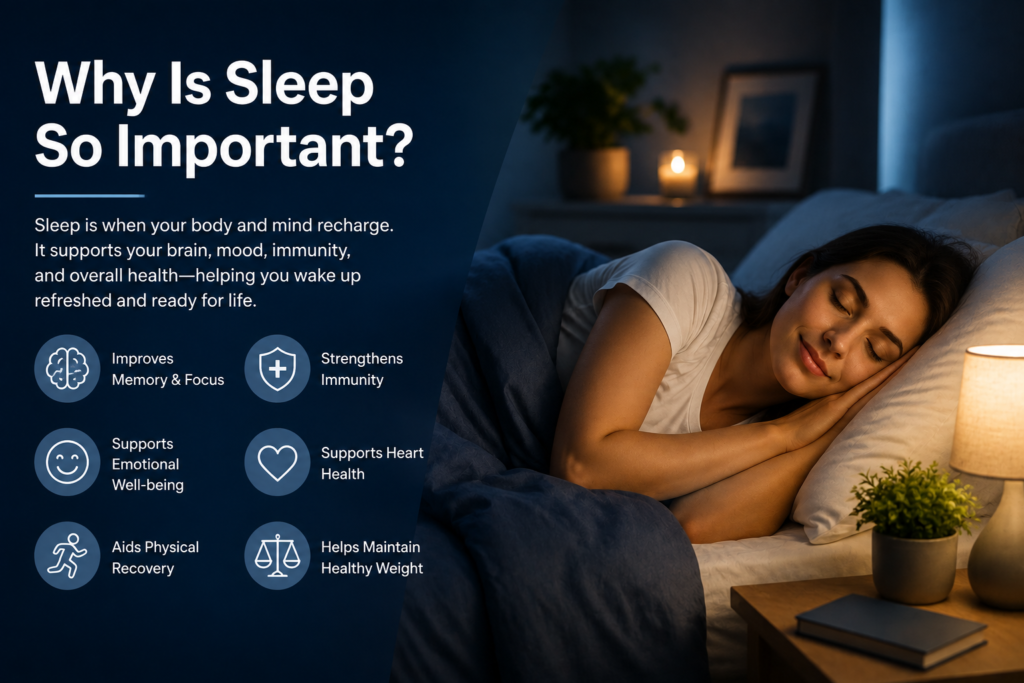
Sleep is not simply a period when your body switches off. It is an active biological process during which the body and brain carry out important functions.
Adequate sleep supports memory, concentration, learning, mood, physical recovery, and normal immune function. Consistently poor sleep can make everyday activities more difficult and may affect overall health over time.
Sleep also plays an important role in emotional regulation. After a poor night’s sleep, ordinary problems can feel more difficult to handle. You may become more irritable, less focused, or more easily overwhelmed.
For this reason, improving sleep is not just about feeling less tired in the morning. It is part of building a healthier daily routine.
How Much Sleep Do You Need?
The amount of sleep a person needs varies by age and individual circumstances.
For most adults, around 7 to 9 hours of sleep per night is generally recommended. Teenagers usually need more, while younger children need substantially more sleep.
However, sleep quality matters as well as quantity. Spending eight hours in bed does not necessarily mean you received eight hours of restorative sleep.
If you regularly wake up feeling exhausted despite allowing enough time for sleep, it may be worth examining your sleep habits, environment, schedule, or possible underlying causes.
1. Keep a Consistent Sleep Schedule
One of the simplest ways to improve sleep is to maintain a relatively consistent bedtime and wake-up time.
Your body has an internal timing system, often called the circadian rhythm, that helps regulate sleep and wakefulness. Keeping a regular schedule can help your body anticipate when it is time to sleep.
Try to:
- Go to bed at approximately the same time each night.
- Wake up at approximately the same time each morning.
- Keep your schedule reasonably consistent on weekends.
- Avoid regularly shifting your sleep schedule by several hours.
You do not have to follow your schedule perfectly. The goal is consistency over time rather than perfection every night.
2. Get Enough Natural Light During the Day
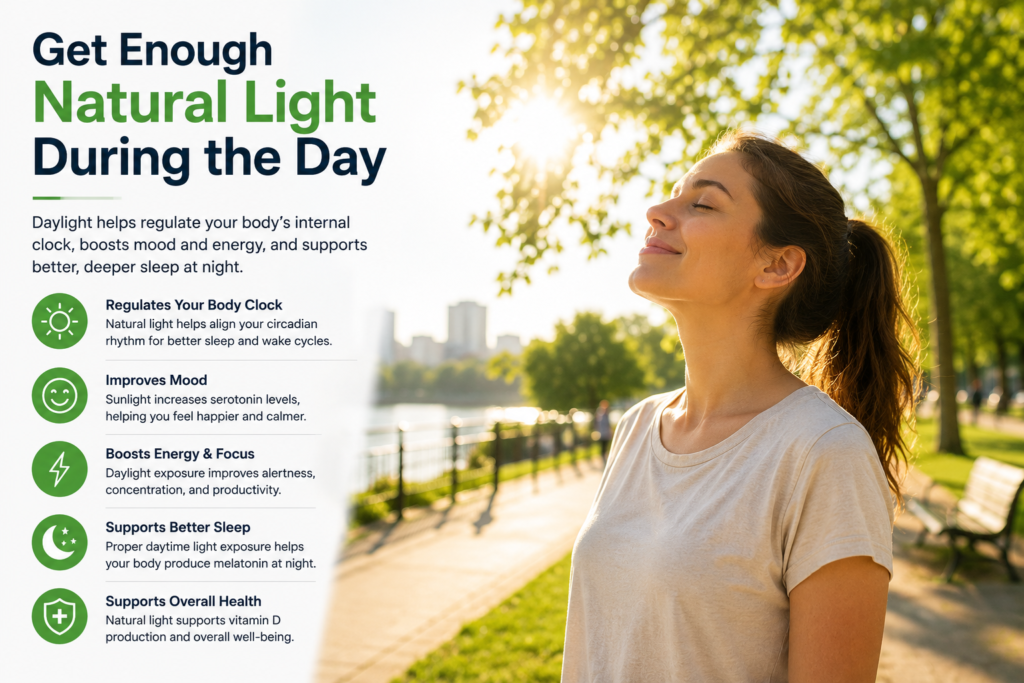
Light is one of the strongest signals influencing your body’s internal clock.
Getting exposure to natural light during the daytime can help reinforce the difference between your body’s daytime and nighttime environments.
If possible, spend some time outdoors during the day. Morning light can be particularly useful for establishing a consistent daily rhythm.
This is especially important if you spend most of the day indoors under artificial lighting.
3. Create a Relaxing Bedtime Routine
Your brain does not always transition instantly from a busy day to sleep.
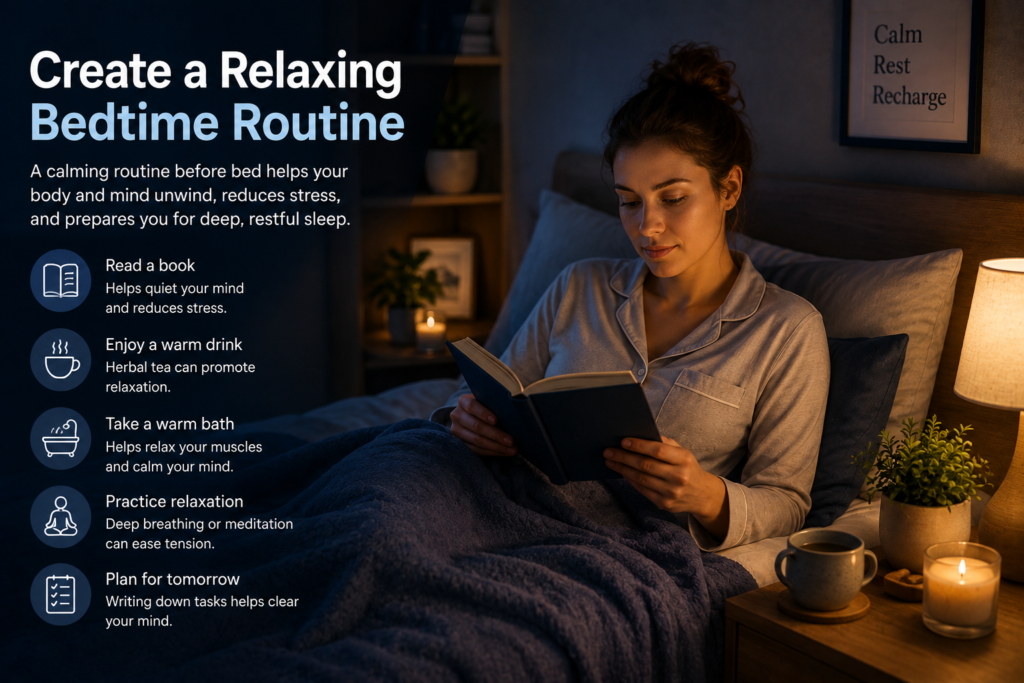
A predictable bedtime routine can give your body and mind a signal that the day is coming to an end.
Your routine might include:
- Taking a warm shower or bath
- Reading a physical book
- Gentle stretching
- Listening to calm music
- Preparing clothes for the next morning
- Writing down tomorrow’s tasks
- Practicing slow breathing or relaxation exercises
The specific activities matter less than whether they help you become calm and relaxed.
Try to avoid turning bedtime into a period of work, arguments, intense entertainment, or stressful decision-making.
4. Make Your Bedroom Sleep-Friendly
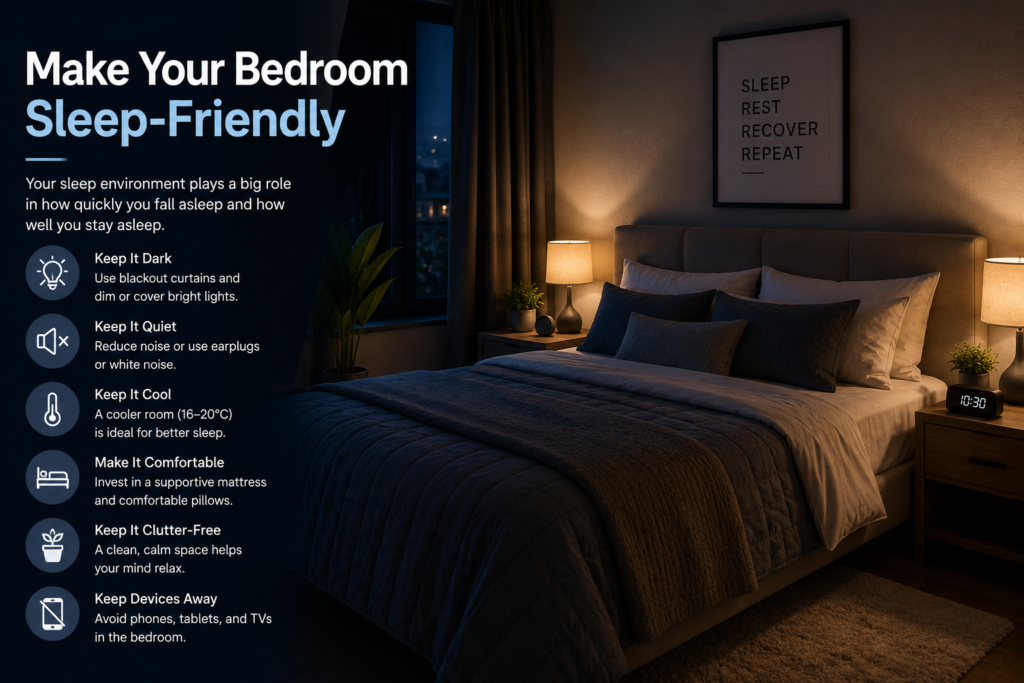
Your sleeping environment can have a surprisingly large effect on sleep quality.
Ideally, your bedroom should be dark, quiet, comfortable, and relatively cool.
Consider:
- Using curtains or blinds to reduce outside light.
- Covering bright lights from electronics.
- Reducing unnecessary noise.
- Using earplugs or white noise if appropriate.
- Keeping the room at a comfortable temperature.
- Choosing a mattress and pillow that provide adequate support.
- Keeping your bedroom reasonably clean and uncluttered.
You do not need an expensive bedroom makeover. Small environmental changes can make the space more conducive to sleep.
5. Be Careful With Caffeine
Caffeine can increase alertness, which is useful during the day but potentially unhelpful close to bedtime.
Coffee is the most obvious source, but caffeine is also found in tea, energy drinks, cola, chocolate, and some other products.
People differ in how strongly caffeine affects them. If you have trouble sleeping, consider reducing caffeine later in the day and observe whether your sleep improves.
Rather than focusing only on a specific cutoff time, pay attention to how your body responds. Someone who is particularly sensitive to caffeine may need to avoid it earlier than someone who metabolizes it more quickly.
6. Avoid Heavy Meals Too Close to Bedtime
Going to bed extremely hungry or uncomfortably full can make it harder to sleep.
Large or heavy meals close to bedtime may cause discomfort for some people, particularly if they are prone to indigestion or reflux.
Try to finish larger meals with enough time before bed for digestion. If you genuinely feel hungry later, a small, simple snack may be more comfortable than going to bed very hungry.
There is no single bedtime eating rule that works for everyone. Individual tolerance matters.
7. Limit Alcohol as a Sleep Strategy
Alcohol can make some people feel sleepy initially, but feeling sleepy is not the same as getting consistently restorative sleep.
Using alcohol specifically to fall asleep can become an unhealthy habit and may interfere with normal sleep patterns.
If you are struggling with sleep, it is better to build a consistent sleep routine than to rely on alcohol as a sleep aid.
8. Exercise Regularly
Regular physical activity can support healthy sleep.
Exercise may help reduce stress, improve physical health, and make it easier for some people to fall asleep at night.
You do not necessarily need an intense workout. Walking, cycling, swimming, strength training, sports, or other enjoyable activities can contribute to an active lifestyle.
If exercising close to bedtime makes you feel energized rather than relaxed, move your workout earlier in the day and see whether that makes a difference.
The most important factor is finding an activity you can perform consistently.
9. Manage Stress Before Bed
A tired body does not always mean a quiet mind.
Many people lie down at night and suddenly begin thinking about work, money, relationships, tomorrow’s responsibilities, or unfinished tasks.
Creating a short “mental shutdown” routine can help.
Before bed, try writing down:
What needs to be done tomorrow?
What am I worried about?
What can I realistically deal with tomorrow?
Putting thoughts on paper can make them feel more organized and may prevent your mind from repeatedly cycling through the same concerns.
Relaxation techniques, slow breathing, meditation, and gentle stretching can also be useful for some people.
10. Be Careful With Screens Before Bed
Phones, tablets, computers, and televisions can become part of the bedtime routine, but late-night screen use can make it harder for some people to wind down.
There are two separate issues to consider.
First, screens can expose you to light that may affect your body’s timing signals. Second, the content itself can keep your brain highly engaged.
An intense video, social media argument, work email, breaking-news story, or competitive game may be far more stimulating than a quiet book.
If you struggle with sleep, experiment with reducing stimulating screen activity before bed.
You do not necessarily have to eliminate technology completely. The goal is to create a transition from stimulation to relaxation.
11. Avoid Long or Late Naps
Naps can be useful, particularly when you are genuinely tired. However, long naps or naps late in the day can reduce your sleep drive at night.
If you regularly have difficulty falling asleep at bedtime, experiment with shortening your naps or taking them earlier.
On the other hand, if you work unusual hours or have a schedule that requires daytime sleep, your strategy may need to be different.
The right approach depends on your overall sleep schedule.
12. Do Not Force Yourself to Sleep
One common mistake is staying in bed for a long time while becoming increasingly frustrated about not sleeping.
You may start thinking:
“Why am I still awake?”
“I have to sleep now.”
“Tomorrow is going to be terrible.”
That anxiety can make relaxation even more difficult.
If you are unable to sleep and becoming increasingly frustrated, getting up for a quiet activity in low light may be more helpful than repeatedly checking the clock.
Return to bed when you feel sleepy again.
The aim is to keep your bed associated with sleep rather than hours of worrying about sleep.
13. Stop Checking the Clock
Constantly watching the clock can turn sleep into a performance test.
You wake up, check the time, calculate how many hours remain before your alarm, and become increasingly concerned.
That mental cycle can increase stress.
If clock-watching makes your sleep anxiety worse, consider turning the clock away from the bed or keeping your phone out of immediate reach.
14. Do Not Depend on Your Phone as an Alarm Clock
Keeping your phone beside your pillow creates an easy opportunity to check messages, social media, news, email, or notifications when you wake during the night.
Instead, consider using a basic alarm clock and keeping your phone farther away from the bed.
This small change can remove one of the biggest sources of nighttime distraction.
15. Track Your Sleep Patterns
This could explain using a simple sleep diary to record bedtime, wake time, nighttime awakenings, caffeine, naps, exercise, and how rested you feel.
What Is Sleep Hygiene?
Sleep hygiene refers to the habits and environmental conditions that support healthy sleep.
Good sleep hygiene generally includes:
- Maintaining a regular sleep schedule
- Creating a comfortable sleep environment
- Getting adequate daytime activity
- Managing caffeine and alcohol consumption
- Establishing a relaxing bedtime routine
- Limiting stimulating activities before bed
- Using the bedroom primarily for sleep and relaxation
- Responding appropriately when you cannot sleep
Sleep hygiene is useful, but it is not a magic solution. Persistent insomnia or another sleep disorder may require more than lifestyle changes.
Common Sleep Mistakes to Avoid
Sometimes improving sleep is less about adding another habit and more about removing habits that work against you.
Common mistakes include:
Staying up extremely late and sleeping in regularly
This can make it harder to maintain a stable sleep schedule.
Using your bed as an office
Working, studying, eating, and watching stressful content in bed can weaken the mental association between bed and sleep.
Drinking caffeine late in the day
Even when you feel capable of falling asleep, caffeine can still affect sleep for some people.
Using alcohol to fall asleep
It may make you drowsy but is not a reliable long-term sleep strategy.
Exercising only when you feel motivated
A consistent activity routine is generally more useful than occasional intense workouts.
Spending hours on your phone in bed
This can keep both your brain and your attention engaged when you are trying to wind down.
Trying to compensate for poor sleep with an irregular schedule
Sleeping much later after a bad night may feel helpful temporarily but can make your normal schedule harder to maintain.
What Should You Do If You Wake Up During the Night?
Waking briefly during the night can happen even when you generally sleep well.
The problem is often not the brief awakening itself but becoming fully alert and frustrated afterward.
If you wake up:
- Avoid immediately checking your phone.
- Avoid repeatedly checking the clock.
- Keep the lights dim.
- Try to remain relaxed.
- If you cannot fall back asleep and become frustrated, get up and do something quiet.
- Return to bed when you feel sleepy.
If nighttime awakenings happen frequently and affect your daytime functioning, consider discussing them with a healthcare professional.
Can You Improve Sleep Naturally?
In many cases, healthy lifestyle and environmental changes can improve sleep.
Start with the basics rather than attempting to change everything at once.
For example, you could begin with:
Week 1: Establish a consistent wake-up time.
Week 2: Add regular daytime movement and outdoor light exposure.
Week 3: Create a 30- to 60-minute wind-down routine.
Week 4: Improve your bedroom environment and reduce late-night stimulation.
Small changes that you can maintain are usually more useful than a complicated routine that lasts only a few days.
When Should You Talk to a Doctor About Sleep Problems?
Occasional difficulty sleeping is common. Persistent or severe sleep problems deserve more attention.
Consider speaking with a healthcare professional if:
- You regularly struggle to fall asleep or stay asleep.
- You frequently wake up feeling unrefreshed.
- Excessive daytime sleepiness interferes with daily life.
- You regularly wake up gasping, choking, or struggling to breathe.
- You have been told that you snore loudly or stop breathing during sleep.
- Sleep problems are affecting your work, studies, relationships, or safety.
- You rely regularly on sleep medication or substances to sleep.
- Your sleep problems continue despite consistent lifestyle changes.
Conditions such as chronic insomnia and sleep apnea can require professional assessment and treatment. Lifestyle improvements are valuable, but they should not replace medical evaluation when symptoms are persistent or concerning.
A Simple Daily Routine for Better Sleep
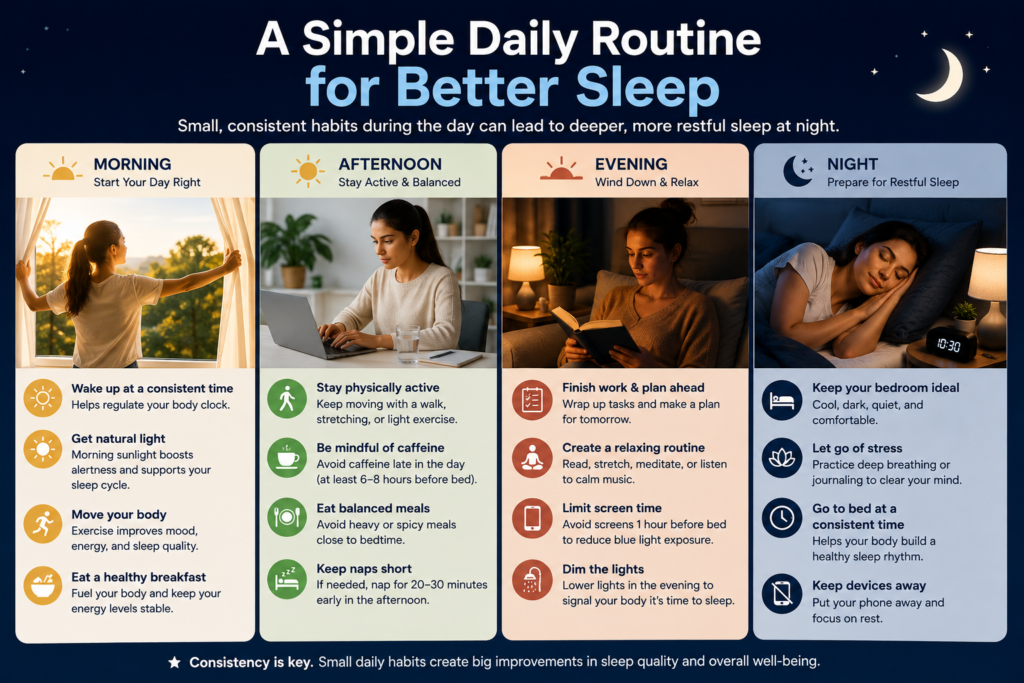
A practical sleep routine does not need to be complicated.
Morning
- Wake up at a consistent time.
- Get natural light.
- Move your body.
- Start the day with a normal breakfast or meal routine if appropriate for you.
Afternoon
- Stay physically active.
- Avoid excessive caffeine late in the day.
- Keep naps short or avoid them if they interfere with nighttime sleep.
Evening
- Finish demanding work before your wind-down period.
- Eat in a way that leaves you comfortable at bedtime.
- Reduce highly stimulating activities.
- Dim the environment if practical.
- Follow a predictable relaxation routine.
Night
- Keep your bedroom dark, quiet, and comfortable.
- Put your phone away.
- Go to bed when you are ready for sleep.
- If you cannot sleep and become frustrated, briefly leave the bed and return when sleepy.
The Bottom Line: Better Sleep Starts With Consistency
There is no single trick that guarantees perfect sleep every night.
Better sleep usually comes from a combination of consistent habits: keeping a regular schedule, getting daylight and physical activity during the day, creating a relaxing evening routine, managing caffeine and alcohol, making your bedroom comfortable, and reducing unnecessary stimulation before bed.
Most importantly, do not treat sleep as something you have to “win.” A healthy sleep routine is built gradually.
Start with one or two changes you can realistically maintain. Once those become automatic, add another.
And if persistent sleep problems continue despite your best efforts, do not simply accept constant exhaustion as normal. Sleep difficulties can sometimes have underlying causes that deserve professional attention.
Good sleep is not a luxury. It is one of the basic building blocks of a healthy life.