What Is Finance? A Complete Beginner’s Guide (2026)

What Is Finance? A Complete Beginner’s Guide (2026)
Introduction
Finance is an essential part of everyday life. Whether you’re saving money, buying a home, running a business, investing in stocks, or planning for retirement, finance influences nearly every financial decision you make.
At its core, finance is about managing money wisely. It helps individuals, businesses, and governments make informed decisions about earning, spending, saving, investing, and borrowing money to achieve their goals.
As technology continues to transform the global economy, financial knowledge has become more valuable than ever. Understanding finance can help you build wealth, avoid debt, manage risks, and prepare for a secure financial future.
In this guide, you’ll learn what finance is, why it’s important, the different types of finance, key financial concepts, real-world examples, and future trends shaping the financial industry.
What Is Finance?
Finance is the management of money and other financial resources. It involves planning, saving, investing, borrowing, budgeting, and making financial decisions to achieve personal or business objectives.
Simply put, finance is about making smart decisions with money.
Individuals use finance to manage personal expenses and savings, businesses use finance to grow and invest, and governments use finance to provide public services and support economic development.
Why Is Finance Important?
Finance plays a crucial role in achieving financial stability and growth.
Helps Manage Money
Finance teaches people how to budget, control spending, and make better financial decisions.
Builds Wealth
Smart financial planning and investing allow individuals and businesses to grow their wealth over time.
Supports Business Growth
Businesses rely on finance to manage operations, invest in new opportunities, and expand into new markets.
Reduces Financial Risk
Understanding finance helps people prepare for emergencies, avoid unnecessary debt, and manage financial uncertainty.
Improves Long-Term Planning
Finance helps individuals and organizations prepare for future goals such as education, retirement, or business expansion.
Types of Finance
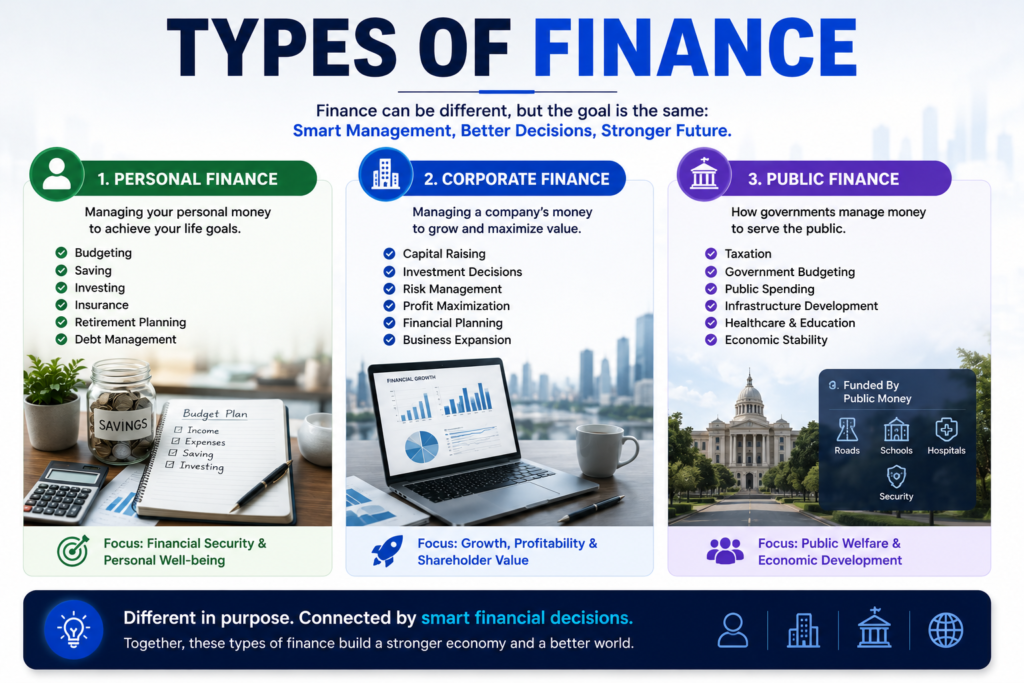
Finance is generally divided into three main categories.
Personal Finance
Personal finance focuses on managing an individual’s money.
Examples include:
- Budgeting
- Saving
- Investing
- Retirement planning
- Insurance
- Debt management
Corporate Finance
Corporate finance deals with financial decisions made by businesses.
It includes:
- Raising capital
- Managing company expenses
- Investment decisions
- Business expansion
- Financial reporting
Public Finance
Public finance involves how governments collect and spend money.
It includes:
- Taxes
- Government budgets
- Public infrastructure
- Healthcare
- Education
- Economic development
Key Financial Concepts

Understanding these concepts provides a strong financial foundation.
Budgeting
Planning how income will be spent and saved.
Saving
Setting aside money for future needs and emergencies.
Investing
Using money to purchase assets that may increase in value over time.
Borrowing
Obtaining money through loans or credit that must be repaid with interest.
Interest
The cost of borrowing money or the reward earned from saving and investing.
Risk and Return
Higher potential returns often involve higher levels of financial risk.
Real-World Examples of Finance
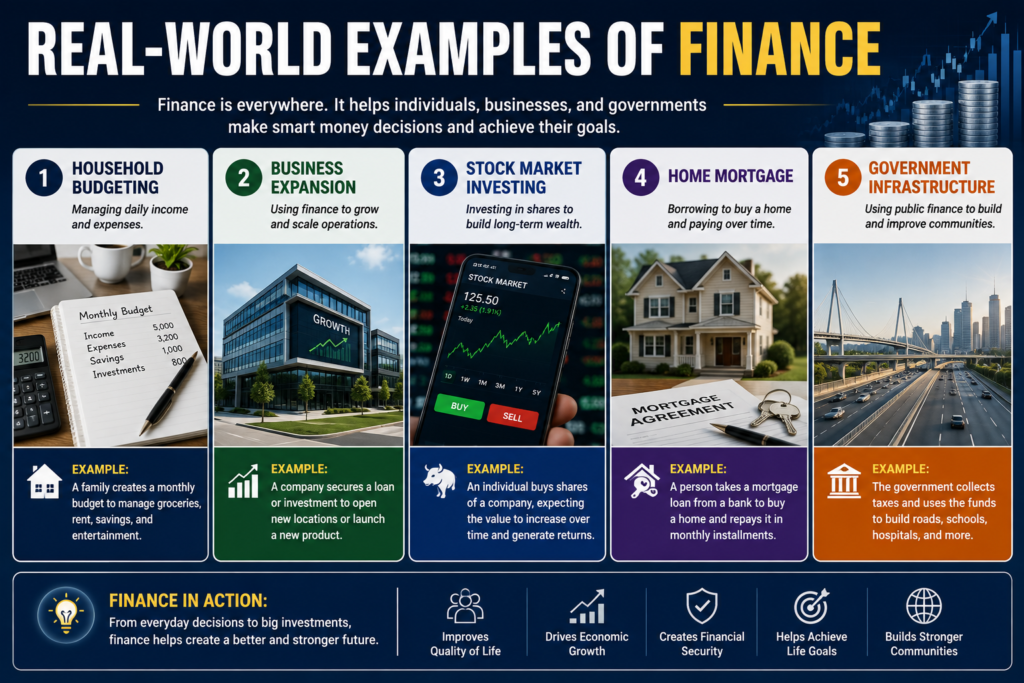
Household Budgeting
Families use finance to manage monthly income and expenses.
Business Expansion
Companies borrow money or raise investment capital to open new locations or launch products.
Stock Market Investing
Individuals invest in shares to grow wealth over the long term.
Home Mortgages
Banks provide loans that allow people to purchase homes over several years.
Government Infrastructure
Governments use public finance to build roads, schools, hospitals, and transportation systems.
Common Financial Mistakes
Many people struggle financially because of avoidable mistakes.
- Spending more than they earn
- Not following a budget
- Ignoring emergency savings
- Taking on excessive debt
- Investing without research
- Failing to plan for retirement
- Relying too heavily on credit cards
Avoiding these habits can significantly improve long-term financial health.
How to Improve Your Financial Skills
Create a Budget
Track your income and expenses every month.
Build an Emergency Fund
Aim to save enough money to cover several months of essential expenses.
Learn About Investing
Understand basic investment options before investing your money.
Reduce Unnecessary Debt
Pay off high-interest debt whenever possible.
Continue Learning
Financial knowledge grows through books, courses, and reliable educational resources.
The Future of Finance

Technology is rapidly changing the financial industry.
Artificial Intelligence is improving fraud detection, investment management, and customer service. Digital banking allows people to manage finances from anywhere, while blockchain technology is creating new possibilities for secure financial transactions.
Financial technology (FinTech), mobile payments, digital wallets, and automated investing platforms continue to make financial services faster, more accessible, and more personalized.
Individuals who understand both traditional financial principles and emerging technologies will be better prepared for the future economy.
Frequently Asked Questions
What is finance in simple words?
Finance is the management of money through budgeting, saving, investing, borrowing, and planning for future financial goals.
Why is finance important?
Finance helps individuals, businesses, and governments make informed financial decisions, manage risks, and achieve long-term financial stability.
What are the three main types of finance?
The three primary types are:
- Personal Finance
- Corporate Finance
- Public Finance
What is the difference between saving and investing?
Saving focuses on protecting money for future use, while investing aims to grow money through assets such as stocks, bonds, or real estate.
Can anyone learn finance?
Yes. Basic financial knowledge is valuable for everyone and can greatly improve financial decision-making regardless of income or profession.
Conclusion
Finance is one of the most important life skills anyone can develop. From managing daily expenses to building long-term wealth, financial knowledge empowers individuals and businesses to make smarter decisions and prepare for the future.
By understanding budgeting, saving, investing, borrowing, and risk management, you can build a stronger financial foundation and achieve greater financial security. As technology continues to reshape the financial world, staying informed will become even more valuable in the years ahead.